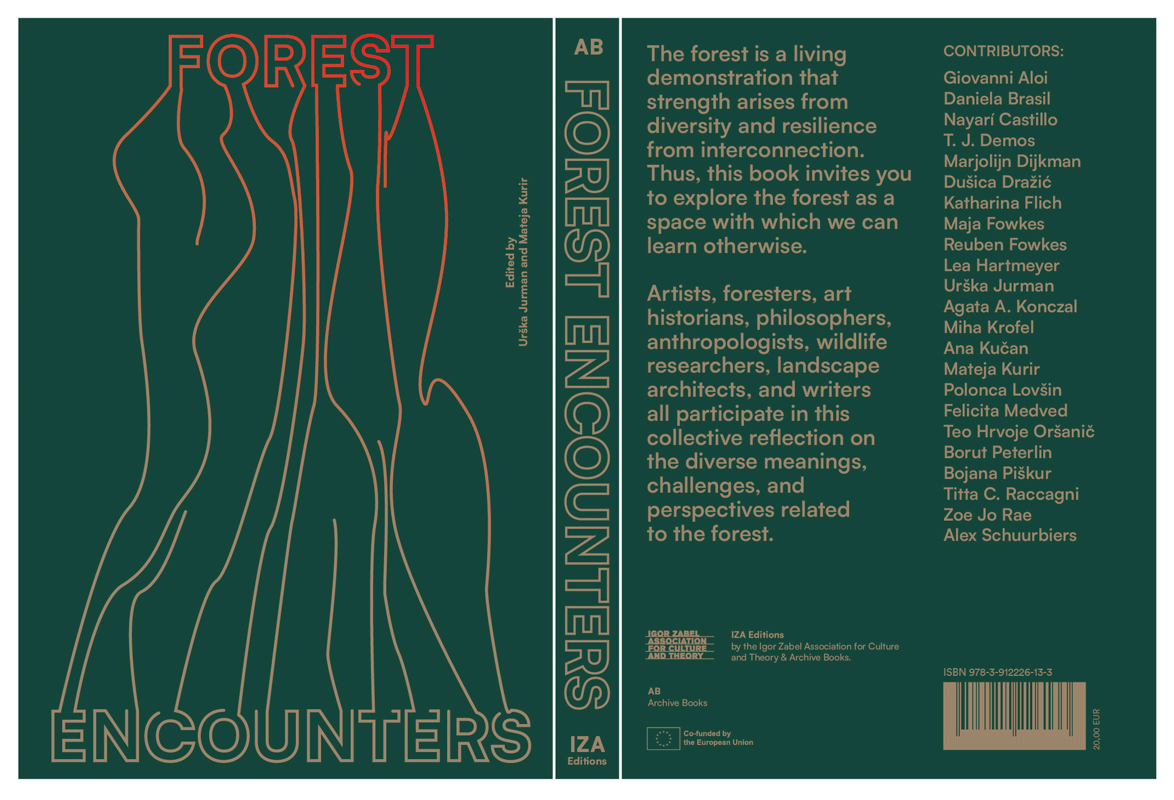
Forest Encounters
Edited by Urška Jurman and Mateja Kurir
Contributors
Giovanni Aloi, Daniela Brasil and Nayarí Castillo, T. J. Demos, Marjolijn Dijkman, Dušica Dražić, Katharina Flich, Maja Fowkes and Reuben Fowkes, Lea Hartmeyer, Urška Jurman, Agata A. Konczal, Miha Krofel, Ana Kučan, Mateja Kurir, Polonca Lovšin, Felicita Medved, Teo Hrvoje Oršanič, Borut Peterlin, Bojana Piškur, Titta C. Raccagni, Zoe Jo Rae, Alex Schuurbiers
Design and layout by Rafaela Dražić
Download the book from this link.
About the book
The Forest Encounters book invites you into the forest and its many meanings. It brings together voices from different disciplines, geographies, and cultures. Artists, foresters, art historians, philosophers, anthropologists, wildlife researchers, landscape architects, and writers all participate in this collective reflection on the diverse meanings, challenges, and perspectives related to the forest.
The goal of the Forest Encounters European cooperation project (2023–2025), of which this book is the final publication, was to examine the forest and the human relationship to it through art, science, and the humanities. The project and the book approached the forest as a site of interconnection and also as a space of conflict where environmental concerns confront diverse political, social, and economic pressures. By acknowledging both the human and more-than-human perspectives, they explored how forests are crucial for the mitigation of the climate crisis and the preservation of biodiversity, and how they function both as sources of livelihood and cultural heritage but also as places of regeneration, healing, and reflection. The forest is also important as a value in and of itself, and yet forest ecosystems are increasingly threatened by the effects of climate change, urban expansion, and profit-driven deforestation.
The project and this book contribute to imagining and shaping a future of and for the forest that is more inclusive, based on interdisciplinary collaboration, and rooted in nature-based solutions. We ask the following questions: What can we learn with and through the forest? How can we face the challenges of forest management in the era of climate and biodiversity crises? What do stories of forest disasters reveal about contemporary society? How has artistic engagement with forests evolved? What kind of forest do we wish for and what kind of forest do we need for the future? What do we need to make that happen?
A wide range of contributors in the book respond to these questions from their unique standpoints. Essays are contributed by social and cultural anthropologist Agata A. Konczal, art historian and curator Bojana Piškur, landscape architect and professor Ana Kučan, art historian and theorist Giovanni Aloi, art historians Maja and Reuben Fowkes, and philosopher and researcher Mateja Kurir. Complementing these are interviews with art historian and theorist T. J. Demos, forester and then director of the Institute of the Republic of Slovenia for Nature Conservation Teo Hrvoje Oršanič, art historian Giovanni Aloi, and wildlife researcher and scholar Miha Krofel.
In addition, four artistic research projects by Polonca Lovšin, Dušica Dražić, Marjolijn Dijkman, and Nayarí Castillo present diverse ways in which artists can engage with forest and forest-related topics.
The book also includes selected contributions from the Forest Encounters Glossary as well as poems, short stories, and essays by Felicita Medved, Katharina Flich, Titta C. Raccagni, Lea Hartmeyer, Zoe Jo Rae, and Alex Schuurbiers, selected through an open call of the Forest Encounters project.
Finally, Borut Peterlin’s photographs provide a visual accompaniment to the diverse contributions in the book.
The forest is a living demonstration that strength arises from diversity and resilience from interconnection. Thus, this book invites you to explore the forest as a space with which we can learn otherwise.
Proofreading
Erica Johnson Debeljak, Ahilan Ratnamohan
Language editing
Erica Johnson Debeljak
Translator
Katja Kosi (from Slovene to English)
Published by Igor Zabel Association for Culture and Theory, Ljubljana
Co-published by Archive Books, Berlin
Ljubljana and Berlin, 2025
Co-funded by the European Union, Creative Europe Program.
ISBN 978-961-94691-5-6 (Igor Zabel Association for Culture and Theory)
ISBN 978-3-912226-13-3 (Archive Books)
COBISS.SI-ID 262482947